The world economy was hit by a major global economic recession in 2009 due to bank failures, from which it had hardly recovered by 2020 when a virus pandemic created another global economic recession though of shorter duration.
But a Ukraine-Russia war followed that soon involved other countries applying strong trade sanctions that restrict world trade and prolong world poverty further as well as reducing much needed climate action.
Countries rich and poor are really trying to maintain production and trade and climate action but with varying degrees of success.
2024 sees poorer countries facing their highest debt repayment costs for 25 years.
Poverty campaign group Debt Justice published figures on 11 April 2023 showing that 91 countries will spend on average 16.3% of their revenues on external debts this year, an increase of nearly 150% since 2011 when that figure was 6.6%.
Sri Lanka's external debt payments this year amount to 75% of government revenue, with 65.6% for Laos, 57.8% for Dominica and 46.7% for Pakistan.
And the World Bank reports that around 46% of poor-country debt repayments are to non-Chinese private lenders, 30% to multilateral institutions like the IMF and World Bank, 12% to other governments like USA and UK and 12% to Chinese public and private lenders.
Also current global climate change is global adversity and is unsettling many people and many governments, and can increase poverty.
Hence climate change adversity really needs people working together more, but can instead increase conflict and divisions making its fixing more difficult.
But poverty has existed for a
very long time, and to varying extents it remains worldwide still now in this 21st century. But to 2024 the 21st century has seen China especially
and also India and some Latin America most reducing poverty - with Africa, USA and UK doing worst with any
economic progress chiefly benefiting the rich, but maybe hopefully this may slowly improve somewhat. In primitive
societies it was most often the case that everybody was
equally poor, but more modern societies have generally tended
to involve poverty being confined to an often substantial
minority only - though this can often harm those
concerned even more than universal poverty does.
Poverty is very harmful to those affected including their health and lifespan, and is also very harmful to
societies and to the world generally and it is not necessary.
2024 has
many countries still in a recession which since 2008 has generally increased poverty. The UN food
agency reported world food prices reaching their highest level ever recorded, though 2016 saw this moderating but still not averting hunger for many. And
2024 does see extreme famine in parts of Africa now especially affecting
Somalia. Recent years have seen richer G20
countries doing £trillion-plus bailouts of their misrun banks,
while charities call for more aid for poor countries to
prevent the economic crisis from destroying more poor people's
lives as many poorer countries are being hit by dramatic
declines in trade and foreign investment. But the UN is
now reporting that recent cuts in aid by richer countries and
poor investment practices have been increasing poverty in Africa, and worldwide
now the poor are facing increased hardship. In 2014 the World Bank reduced resources to combat world poverty, so keeping it relevant means it now focusing mainly on areas where other donors are reluctant to go, such as fragile and conflict-affected states by 2016 being home to half of the world's poorest people.
(See http://uk.finance.yahoo.com/news/world-bank-ties-strategy-poverty-142103892.html) The
present economic downturn has also increased the
abandonment or murder of children and of elderly women in some poorer countries. Often with 'justifications'
that they are witches or devil-possessed, with total annual numbers estimated at millions.
And 2010 saw a UK Deputy Prime Minister backing the old unhelpful view
that 'poverty affects children little if they have good
parenting' and also UK and other governments supporting immigration from poorer countries for a younger cheaper population - though the false claimed 'benefits' of poverty and cheap labour only discourage business innovation progress and favour business inefficiency.
In 2023 Italy the Government and the Catholic Church and Pope were together strongly pushing 'pro-population' (pro-poverty) policies,
though in modern societies such policies can in fact tend to reduce population and not to increase population.
(see
Poverty in Italy.)
And population decrease may be better countered by helping make the having and raising of children easier and more profitable.
Yet many such governments are pledging to 'eliminate global poverty' by 2030, though it is maybe not as good a target as it
looks. The most hopeful fact is that in recent years poverty has been greatly cut in China and somewhat in India and Latin America, and now China is helping the most with cutting poverty elsewhere. But for the latest news on 21st century famine see www.fews.net
Reduction in poverty in China has been impressive and has been based on scientific policies of limiting population and modernisation, though the limiting population may have been maintained rather too long perhaps.
But as most Protestant Christian countries long supported birth control, generally Catholic Christian, Muslim and Hindu churches opposed any birth control.
Some developing countries are also aiming for substantial reduction in poverty like China based on scientific modernisation - though if they can reach the same level of success
without limiting population only time will tell. However many poor countries seem very unlikely to see reductions in poverty soon,
having strong forces that are often religious which are opposed to any modernisation and often also to any population control.
One reasonably good recent measure of world poverty is given in the
World Bank 2018 poverty statistics map below -
;
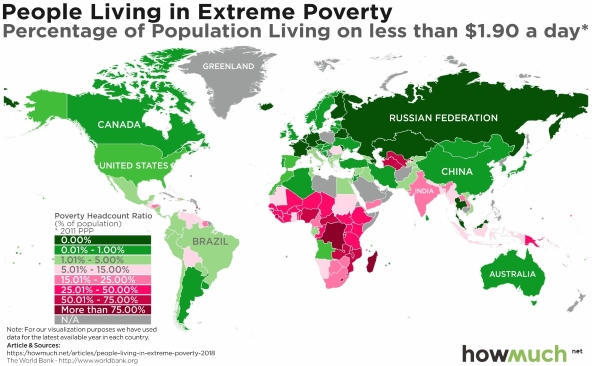
In this map basicly more red is more poverty and more green is less poverty, and this map shows that some
richer countries can have some real poverty. (See
Poverty Map.)
Absolute poverty involves people and
their children having extreme difficulty in merely surviving.
Such poverty at its worst can involve hunger amounting to
starvation, often combined with inadequate shelter or housing
and clothing. Absolute poverty has been common in more
primitive societies, and is still common in many Third World
countries in Africa, Asia and South America especially where
it can afflict the majority of the population.
But many of today's richer societies like
the USA and UK have a poor who are a minority and
suffer relative poverty - which
generally involves the inability to obtain social necessities
available to the majority and is often intensified by social
exclusion. In a society where 90% rely on their own computer
and car, then those who cannot afford these things may
function badly and are poor and may well be ostracised or
socially excluded (unlike someone richer who chooses to not
have such things and may merely be considered
eccentric).
Hence the answer to what is poverty is not
simple, as poverty does come in different forms and extents,
allowing different definitions of poverty, but it is always
harmful to those concerned and especially harmful to children
whose biological development and survival chances can also be
greatly harmed. Poverty itself means misery to the poor and it
also greatly limits their freedom of life choices and makes
them vulnerable to other various nasty forms of
exploitation including child exploitation. Poverty can also
be very harmful to society as a whole, insofar as it
can maintain a divided conflict society where the poorer
conflict with the richer and acceptance of poverty generally
encourages social badness rather than goodness.
Two issues have been preventing most
governments from handling poverty well ;
1. Most governments in both rich and
poor countries do not see poverty-reduction as being any
priority to them, and so do not make much attempt to reduce
poverty. The wider benefits of reducing poverty are not widely
understood.
2. The few governments in rich or poor
countries that do see poverty-reduction as being of some
priority to them, have commonly wasted much of the resources
they use in mistaken attempts at poverty reduction from not
understanding their best policy options for that.
Recent world food prices have been kept high partly by new Biofuel policies, mostly helping
to maintain global poverty. 2009 also saw richer
countries hit a substantial economic downturn that makes it harder for them to help reduce poverty for some years.
And of course all governments do have other problems to try to
deal with, and also all have some resource limitations that
restrict the actual amount that they can achieve. But
mostly governments could certainly do
better.
For many poorer countries, the current world
recession has also caused family remittances from overseas
workers or migrant workers to fall. As more migrant workers
lose jobs in Western Europe and the USA, remittances to poor
families in Africa, Central Asia and Eastern Europe are
expected to be hardest hit.
The current recession has also badly affected the relative poor in richer countries as a 2012 report about the UK noted.
Lions, Locusts and Plagues.
Human welfare has faced many different problems at times. In the more distant past big predators like lions were a major problem for
killing people though now they are largely a rare concern. Large swarms of Locusts eating plant crops have been a big if occasional
problem and are still very occasionally a major concern. Plagues or Epidemics killing people also tend to being occasional and though
Bacterial Plagues are now much less an issue with modern medicine, Viral Epidemics have proved much harder to deal with and any plague
or epidemic can decimate populations and incapacitate many workers to increase poverty, as was being seen in the 2020-23 coronavirus
epidemic or worldwide pandemic.
NOTE: As well as looking at
the persisting extent of poverty worldwide, as
shown in world poverty maps, this website also seeks to
seriously examine the various real causes of poverty and
the various real possible solutions to poverty. A much better
understanding of world poverty issues and poverty statistics are
really needed to help end poverty.
The menu on the left clicks
to give our Poor in a Rich World, Environment Poverty,
Biological Poverty, Economic Poverty, Exploitation Poverty,
Social Poverty, Poverty in Africa, Poverty in Asia, Poverty in
Latin America, Solutions to World Poverty and other sections -
and each carries further poverty information and informative
links to give a wider picture of poverty
worldwide.